Vasari Sought to Underscore the Prestige of Art as an Intellectual Endeavor
An unusual exhibition foregrounds the Renaissance and Bizarre art of painting on surfaces of semi-precious stone, marble, or slate.
By Rebecca Allan
Anyone who has hiked a mount or combed a beach to seek out unusual stones tin appreciate our shared affinity for the special qualities of rocks—their historic period, origin, resilience, coloration, textures, and shapes. Natural rocks such equally limestone, marble, and slate, formed over millions of years past heat and pressure applied to organic thing, connect us to Earth's geologic history. It is no surprise that quarried stones became a desirable resources for artists, as surfaces for their paintings, during a especially innovative period in Europe between the 15th and 16th centuries.
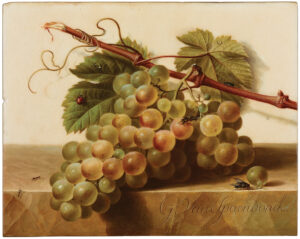
Gerard van Spaendonck, Grapes with Insects on a Marble Superlative, circa 1791–95, oil on marble, 7 3⁄8 10 9 i⁄4 10 1⁄8 in.
The Frick Drove, New York, Gift of Asbjorn R. Lunde, 2012; © The Frick Collection
"Paintings on Stone: Scientific discipline and the Sacred 1530–1800," an exemplary exhibition at the Saint Louis Art Museum (through May 15), brings together more than 70 artworks by 58 artists, featuring 34 different kinds of rock. The initial inspiration for this cross-disciplinary project grew from a commitment made over 20 years agone by Christian B. Peper (1910–2011), a longtime patron of the museum and reader of classical literature, to support the purchase of a small oil painting on lapis lazuli panel by Giuseppe Cesari (1568–1640). Perseus Rescuing Andromeda is a smoldering, jewel-similar painting, no larger than a hand mirror, that catalyzed 15 years of research culminating in this endeavor. Organized past Judith Westward. Mann, Curator of European Fine art to 1800 at the Saint Louis Art Museum, the exhibition includes rarely-seen works transported to Missouri from public and private lenders beyond the earth, assuring that it is a one time-in-a lifetime occurrence.
A relatively unknown attribute of European Renaissance and Bizarre artistic do, painting on slate, porphyry, agate, lapis, and other valuable stones reflected interests in the relationships betwixt art, geology, and philosophy. Every bit nature'south about durable material, rocks were sought out equally painting surfaces non just for their aesthetic beauty only also to reinforce a metaphorical and concrete connectedness with eternity. The incorporation of stone as a surface for painting during the Italian Renaissance also catalyzed philosophical debates about mimesis—the relationship between art and nature—and theparagone—the question of the relative superiority of painting and sculpture. Leonardo da Vinci, Michelangelo, and Giorgio Vasari were amidst the artists and writers who participated in this comparative statement.
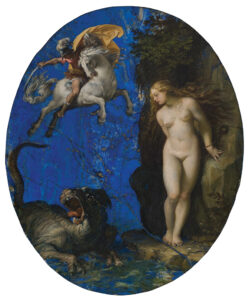
Cavaliere D'Arpino (Giuseppe Cesari), Perseus Rescuing Andromeda, circa 1593–94, oil on lapis lazuli, vii 15⁄16 x half dozen 1⁄viii x i⁄4 in.
Saint Louis Art Museum, Museum Purchase i:2000
Scholarly inquiry into Renaissance art evolved, over fourth dimension, from a chief interest in the subjects of painting to an exploration of how techniques reinforce subject area matter. Since about paintings from the 16th and 17th centuries were executed on wood, linen, or canvas (and occasionally copper), the afterward discovery that stone was actually more common as a painting surface has led to a richer understanding of this tradition. In the 1970s, researchers looked more closely at the sourcing, broadcasting, and apply of stone. Originating with Italian artists who sought out stones and adult techniques for their apply, this do expanded to workshops in Antwerp, Nuremberg, Prague, Seville, and other cultural centers in Europe.
Stones that have been quarried, cut, and polished have been utilized as surfaces for painting since artifact. There are ancient Greek examples of mythological and domestic scenes painted on marble panels, too as 7th-century icon paintings on treated marble (coated first with wax and gilding) at Saint Catherine's Monastery in Sinai, depicting subjects such as the sacrifice of Isaac and Jephthah's daughter. In the 13th century, paintings of apostles in the Basilica of St. Ursula in Cologne were rendered on slate.
In 16th-century Venice, a revival of interest in the classical world, furthered past archaeological discoveries and the press of Greco-Roman texts, was coupled with an influx of Nigh Eastern materials. These cultural intersections prompted artists to experiment with new techniques equally well as to create works on stone that they believed would final forever. In some classical Greek writings, rocks represent the origins of humankind, while in the Bible they are associated with sacred imagery.
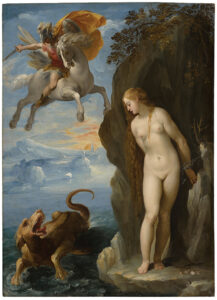
Cavaliere D'Arpino (Giuseppe Cesari), Italian, Perseus Rescuing Andromeda, 1594–95, oil on panel, xx 11⁄xvi ten 14 xv⁄sixteen in.
Sterling and Francine Clark Art Institute, Williamstown, Massachusetts, Image courtesy of the Clark Art Institute
The Venetian painter Sebastiano del Piombo (1485–1547) is credited as a pioneer of—if not the first to develop—the "undercover" methods for oil painting on stone. Each blazon of stone has its own particular density, texture, coloration, thereby influencing a painter's power to impart coloration, and to exploit the cogitating backdrop of stone for naturalistic effects. Chemical analysis of these techniques (including their reproduction in the laboratory past conservation scientists) has shown that the procedure involved the awarding of a mixture of melted wax, resin, and hot oil to the support to ready the stone surface before painting. Given the slippery or varying surface textures of different stones, we tin imagine the necessity of an intermediary layer to clinch the bonding of oil-based pigments.
The near desirable stone in the classical era was marble, favored for its high polish, durability, and color absorption. By 1530, Renaissance artists had begun painting sacred images and portraits on marble, and then increasingly on slate, which was more easily sourced. Slate occurs in ranges of warm to cool grey tones; it has a chalky, relatively opaque surface and contains thin slivers of mica inside its structure that produce a softly glowing quality. Working on slate, artists could easily accomplish a broad coloristic range with fewer pigments. By the tardily 1700s, artists were using a wide array of luxurious stones including agate, alabaster, amethyst, jasper, lapis lazuli, and onyx. The sourcing of these rare stones reflects the all-encompassing industries of mining and send. These international networks are discussed in depth in a compelling essay past Mario Casaburo in the exhibition's catalogue.
In her catalogue essay, curator Judith Mann writes that when the Saint Louis Art Museum acquired Cesari's Perseus Rescuing Andromeda, no 1 could imagine that information technology would be the focal bespeak for her exhibition. The painting'due south eight-inch high lapis lazuli support, Mann emphasizes, was rather significant during a period when virtually lapis supports were "butterflied"—that is, made by slicing the fabric and lining it up along its cutting border, forming a mirror image. One of at least 10 versions of this subject painted on seven different supports by Cesari, the St. Louis motion picture represents Perseus aloft on the horse Pegasus preparing to vanquish the sea monster Cetus and rescue Andromeda, who is chained to a rock. Using stone as a support for a subject area bound to a rock must have provided intellectual delight for the artist likewise as his patrons. The saturated ultramarine blue hue of this semiprecious stone, with its minor flecks of calcite and crystals, added to the high status and worth of such an intimately sized object. Take note: ultramarine paint was reserved about exclusively for painting the Virgin Mary'southward garments; thus it was one of the rarest and near expensive colors.
Francesco Salviati's Portrait of Roberto di Filippo di Filippo Strozzi is painted in oil on carmine and black African "marble." Not a true marble, information technology is actually a rock known as breccia, a type of limestone that has been fractured into angular pieces and then naturally re-cemented by calcite. The cherry reds, blacks and icy whites are the consequence of impurities in the limestone. Salviati complements the ruddy with an emerald-green-painted background, and he leaves the outer edges of the circular rock support unpainted, a possible reference to the sitter's biography. Strozzi lived in Florence until 1538, when he was exiled. Information technology could be that the creative person revealed the stone support because he understood Florentine sense of taste for colored marbles. Furthermore, the circle within a crescent resembles the Strozzi family'due south glaze of arms.
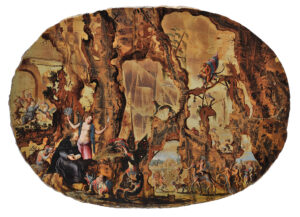
Jacob van Swanenburg, Temptation of St. Anthony, circa 1595–1605, oil on pietra paesina, 24 5⁄eight x xx five⁄8 ten 2 7⁄8 in.
Kunstkammer Georg Laue, Munich/London
Jacob van Swanenburg's Temptation of St. Anthony is painted on pietra paesina. Also known as landscape stone, information technology is patterned with crisscrossing lines—the consequence of limestone having been infilled with thin calcite veins. This textile originated on the body of water floor and also contains atomic number 26 and manganese. In popular 15th- and 16th-century literary accounts, St. Anthony was described as a hermit whose piety was threatened by evil beings. Hither, seated and reading in his black robes, he is tempted by a adult female with a mirror and peacock feathers. A wake of vulture-similar serpents and tormented half-homo beings likely refer to the popular theme of vanitas, the fragile impermanence of life on earth. Jacob van Swanenburg specialized in extraordinary representations of hell. Combining the painted (illusionary) forms of irregular rocks against the actual, amber-colored stone surface with its geometric patterns, he heightens the tension betwixt the eternal and the ephemeral. Working in Rome at the time he made this painting, he may have been introduced to pietra paesina by the Florentine creative person Antonio Tempesta.
The mimetic relationship between the subject of an artwork and the material of its making is axiomatic in Interior of the Jesuit Church in Antwerp, an oil on marble past Wilhelm Schubert van Ehrenberg. The artist cleverly left the white marble unpainted on the lower levels, columns, galleries, and chapel, unifying the stone support and his illusionistic painting in a tour-de-force work that rivals many 17th-century architectural interiors by Dutch painters of the Counter-Reformation. At present known every bit the St. Charles Borromeo Church, the original structure was built only 50 years before the painting was made, from the exact type of marble that the artist painted on. A rare document of the interrelation between an artist's material and subject area, the painting reflects the cultural status of this church, which was celebrated for its reverberant light and use of a blazon of marble that had previously been employed exclusively in Italy.
Portraiture in the High Renaissance sought to express the essence of an individual's soul and graphic symbol as reflected in his or her physiognomy. Sofonisba Anguissola, one of the most accomplished painters of her time, was highly regarded for this skill. An oil portrait she painted on slate, presumably of her brother Asdrubale, has a charged animation coupled with reserved stillness. Anguissola'due south mastery in drawing the facial features and her range of tonal colors for the garment underscore the sitter'southward mood of pensive interiority. The painting may take been made while she was in residence at the court of Madrid. Knowledge of stone paintings in 17th-century Spain is even so evolving, only Philip II endemic several, including one past Titian.
Art historian Laura Gelfand, in her catalogue essay on 15th-century artistic practise, examines the subtle symbolic distinctions between medieval and early-Renaissance artworks made 80 to 100 years prior to the exhibition's selections. Her discussion of how artists played upon the alchemical and illusionistic capacities of paint (to compete or collaborate with nature) enhances our understanding not simply of these otherwise slippery artistic timelines simply also enriches our thinking about contemporary practise. Today, painters are still taken with the endless illusionistic possibilities of pigments made from basis stones and suspended in a binding medium as a vehicle for the magic of realism. We notwithstanding effort to highlight or surpass the inherent beauty of our raw materials.
The notion of a work of art lasting unto eternity may exist challenging to imagine; nearly things deteriorate over time equally a outcome of environmental, climate, and human forces. Nevertheless, the transformation of lithic material in works of art resonates in more recent do, such as in the Excavation of Robert Smithson and Nancy Holt of the 1960s–70s, the gimmicky sculpture of Maya Lin, and the revival of classical architectural painting and conservation techniques by specialists at Evergreen Architectural Arts in New York City. "Paintings on Stone" reminds united states of america that the experiments and accomplishments of Renaissance and Bizarre artists are never petrified simply continually replenished as we uncover cognition virtually the hidden treasures of the past and examine them through new lenses.
Source: https://artmuseum.international/set-in-stone/
0 Response to "Vasari Sought to Underscore the Prestige of Art as an Intellectual Endeavor"
Post a Comment